
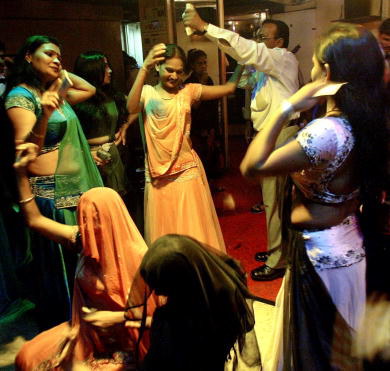
It’s a common elitist Indian assumption that has claimed numerous victims apart from bar girls. There are some people who ‘look’ as if they can speak English and some who don’t. For instance, the popular mindset has it that the burqa is equivalent to being English-challenged. Ask the smart Bori receptionists in their colourful burqas at the swank Saifee Hospital at Charni Road. Visitors usually address them in Hindi and proceed to look embarrassed when they reply in rounded, Convent-educated English.
The burqa poses other linguistic problems too. When Farial Sheikh walks down the street in Mumbai in a sequin-studded burqa, people assume she is from the Gulf, and launch into pidgin Arabic. “Once at Colaba Causeway even a beggar began to whine in Arabic,’’ says a stunned Sheikh. The 24-year-old enjoys calling the bluff of shopkeepers who, assuming she is the keeper of petrodollars, quote crazy prices, only to have her bargain back in robust bambaiya Hindi.
Islamic scholar Zeenat Shaukat Ali blames the media for validating these everyday prejudices. “It labels people with an image which they don’t really deserve,’’ she says. That’s why, she feels, we have preconceived notions of how certain categories of people should look—a terrorist must be bearded, a pandit cannot own a cellphone, a South Indian must wear heavy gold jewellry and speak accented Hindi.
A few years ago, when media professional Waleed Hussain was a commerce student at a Muslim college in Mumbai, he took part in the Brabourne Trophy elocution competition at a college in Jogeshwari. When the beard-sporting boy entered in white kurta, jeans and a pair of Kolhapuris, one of the judges helpfully pointed out, “The competition is in English.’’
Given that fluency in English unfortunately implies a superior socio-economic standing, assumptions of this kind can be insulting and downright snobbish. The unspoken connection between garb and gab is so subconscious that one assumes that those in traditional clothes will respond only in a regional language. Some years ago, 25-year-old Alliance executive Kannan went to visit his grandmother in Chembur. He found a swarthy, lungi-clad man seated comfortably on the floor. Kannan thought he was a villager visiting and was stumped when the man handed him his visiting card which said ‘Creative & Editorial Director’ of a new entertainment channel.
Psychologist Seema Hingorrany calls this mindset “learnt behaviour’’ that we imbibe thanks to the conditioning of teachers, elders, peers and the media. Hingorrany found herself in a similar situation once while addressing a workshop on attention-deficiency in children. She addressed one of the parents who was wearing a sari in the Gujarati style in Hindi. The lady was offended, and Hingorrany had to hastily cover up with, “No Ma’am, it’s because I thought usually parents are more comfortable with Hindi.’’
Rahul Gore, a young sales executive in Key Accounts, became friends with his local paanwalla following a similar misconception. “I assumed he was your regular Kannada paanwalla,” recalls Gore, who was taken aback to find an English daily and a financial newspaper in his tiny shop. “I thought someone had left it there,” says Gore. “Turned out he subscribed to them. He’s an SSC pass, who can read and write in English and maintains excellent everyday accounts, again in English. He even pays income tax,’’ says an impressed Gore.
In the first-class ladies’ compartment of Mumbai’s local trains, all fights take place in English. Recently, public relations executive Rhima Naik, who travels from Goregaon to Churchgate, was witness to a co-passenger’s embarrassment. When a woman in a gaudy pink sari and gajra jumped in at Dadar, a Catholic woman demanded in ringing tones, “Tumhare paas first-class pass hai?” To which the woman replied coolly, “Ma’am, I do. But can you show me yours first?’’ Naik recalls the shock that registered in the otherwise indifferent compartment.
The language stereotype works the other way too. Naik learnt this the hard way. Some years ago, she went to the ABN AMRO bank in Delhi with a friend from the US. The man at the counter was a foreigner, who said the transaction would take at least 20 minutes. “But it actually took an hour, so we started cursing him in Hindi,” says Naik. In between “Itna time laga raha hai, sala’’ their conversation meandered to girly talk of how he would make a “cute husband’’. In the end, of course, she was the one blushing, when he handed her the cash and said smoothly, “Ma’am, mujhe Hindi pata hai aur main sab samjha.’’ And as they blushed, he added, “Thanks.’


